Historical
Close ups of individual Replicants can be seen (in a separate window) by clicking on the appropriate picture.
(The Illustrations in this section are intended to give the visitor as much information as possible about the shapes of the mouldings; the colours are considered to be incidental and are not necessarily correct, as we cannot predict how accurately these might be viewed on any individual system/monitor.)
Replicants reserves the right to change the specification of any item shown on this website.
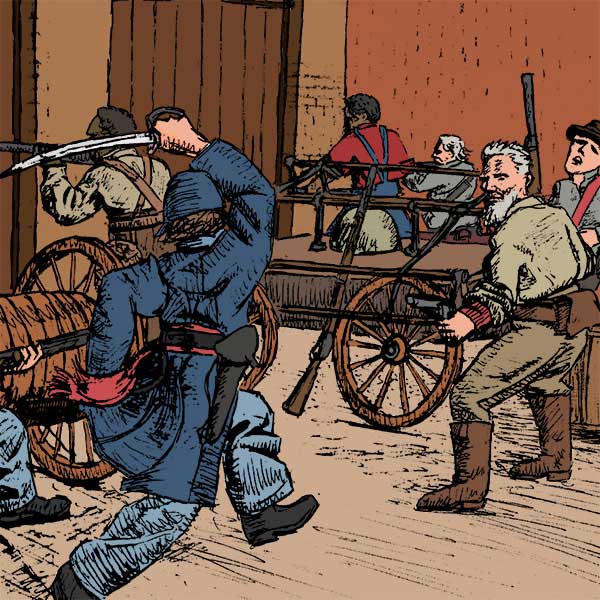
In August 2006 Replicants, in conjunction with Plastic Warrior Magazine, launched a competition to invite readers to design a figure for Replicants to produce.
The winner was Mr. P.R. Jones of Glamorgan with his design for a Rogers' Ranger of the French and Indian wars.
Peter Cole, the Replicants sculptor, has for some time wanted to make a pair of figures in hand-to-hand combat; we therefore took the opportunity to make a second ranger fighting an Iroquois. The existing Replicants Iroquois, which was one of our first figures, fits very comfortably with the other three to complete this new set.
With each set comes a card with a colour picture and some text about the Iroquois confederation and the rangers. This collectable card is the first in a series which will accompany all new four figure sets.

Set of four Iroquois and rangers
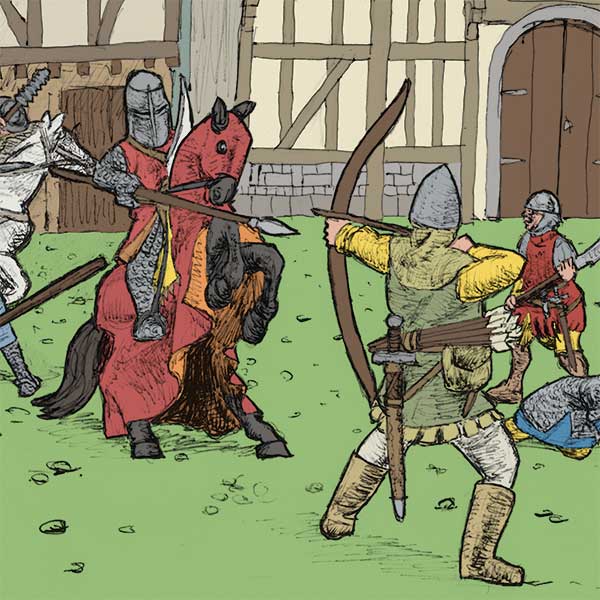
Lots of British toy soldier makers had a Robin Hood set in their plastic figure range yet hardly any of them included enough Sheriff's men-at-arms to put up a decent fight. These medieval thugs are mean, moody and injection-moulded. They'll steal your village, burn your women and ravage your cattle.

REP SM4 Set of eight Sheriff's Men-at-arms. Comprises: Man with spear, crossbowman loading, crossbowman firing (with separate clip-on crossbow), man with axe, man with torch, and man with sword all in silver plastic; a longbowman in tan, and an executioner in black.
For those collectors who want to use pack-mules with figures from other periods, this is a set of two mules and two loads.

REP MT1 Set of two mules and loads.
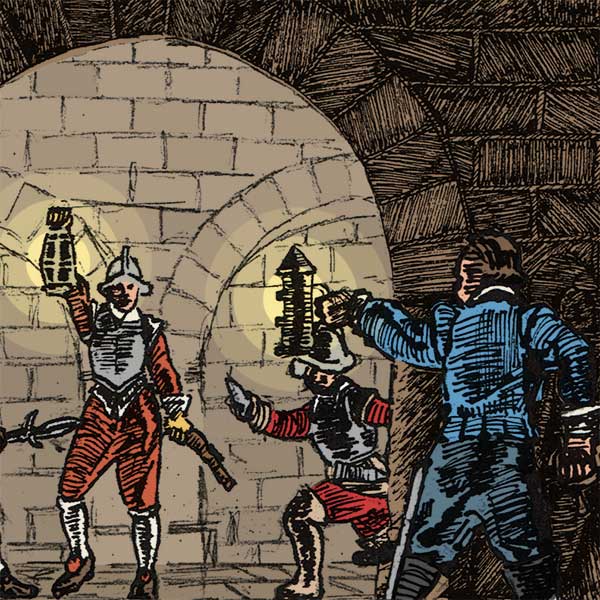
Often remembered as the only man to enter parliament with honest intentions, Guy Fawkes was caught by guards while attempting to blow up the government of the day.

REP GF1 Four figures plus a stack of gunpowder barrels.
Named after their short carbine called a harquebus, these heavy cavalrymen were part of many European armies during the 17th century.

REP HR1 Figures: silver or tan.
A dismounted figure, his horse and a piece of battlefield scenery.

REP HR2 Horse: black; human: silver or tan; wall: grey.

REP MR1 mounted harquebusier

REP 110/109 Seventeenth Century mounted trumpeter and harquebusier.
A set of four musketeers of the 17th Century, suitable for all European countries of the time.


REP6 18th century Iroquois wearing military jacket

Mounted Normans (pair 1)

Mounted Normans (pair 2)

REP D9/D10 Sheriff's man-at-arms sitting
Sheriff's man-at-arms crawling

REP D3/D1 ECW musketeer lying dead.
ECW harquebusier lying wounded.
Replicants is based in Lewes, a town in the south of England. Lewes has many claims to historical significance and here is the beginning of a series which seeks to portray some of the personalities connected to the town’s history.

Top: Tom Paine, writer and revolutionary, lived in Lewes immediately prior to his involvement in the American Revolution. Later he was involved in drawing up the French constitution of 1792 following their revolution.
Middle: Buffalo Bill brought his Wild West show to Lewes on June 7th 1904. This figure is based on a photograph taken of him on that occasion.
Bottom: Simon de Montfort’s army defeated that of Henry III at the battle of Lewes in 1264. This led to the establishment of a parliamentary system in London which is considered to be the ancestor of all parliamentary democracies.
First: Charles I is depicted at his execution, flanked by an officer (an executioner is available in the Replicants range sold as a sheriff’s man). The figure on the right is Oliver Cromwell, leader of the Parliamentarian army.
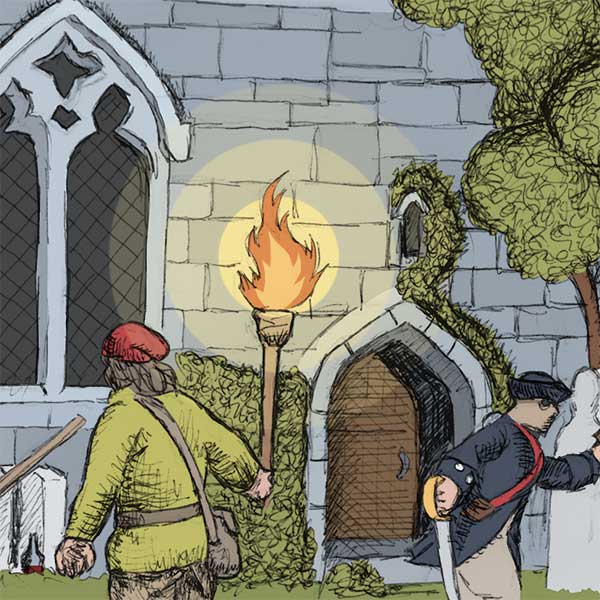
Second: Charles II hid in an oak tree at Boscobel Manor while parliamentarian soldiers searched for him below.
Third: An innkeeper and a serving woman from the 17th century.
Fourth: Two Pikemen, suitable as Royalists or Parliamentarians


Bowmen from the thirteenth century.
At Hastings the Saxons formed a shield wall to resist the charging Norman cavalry. These four figures have bases which fit against each other so that a shield wall can be formed using any combination of the figures.

Scots played an important part in the English Civil War: As well as the four Highlanders this set includes two extra heads with bonnets so that converters can change other English Civil War figures into covenanter Scots.

This figure commemorates the 25th anniversary of the launch of Plastic Warrior magazine - see the magazine's link to this website.